

Introduction
Welcome to Aosta, a city whose ancient roots still shape its streets and monuments today. Rome of the Alps is not just a poetic nickname—it reflects the deep Roman heritage preserved in every corner of Augusta Praetoria. In this introduction, we will explore how Aosta became one of the most strategic Roman settlements north of Italy, and why it still fascinates historians and travelers alike.
From Augusta Praetoria to Aosta
Aosta was known in ancient Rome as Augusta Praetoria. Even the valley itself took the name of Augusta; therefore, the transition from Valle d’Augusta to Valle d’Aosta was a natural linguistic evolution. And honestly—those Romans really left their mark everywhere.
A Strategic Roman Foundation
In the early years of the Roman Empire, the territories beyond the Alps had been conquered, but controlling the provinces required more than military victory. Consequently, the Romans established colonies that provided both military strength and vibrant civilian life throughout the Alpine regions.
Rome of the Alps appears again here
In 25 BC, Emperor Augustus—only two years into his imperial rule—ordered the foundation of Augusta Praetoria. Generals such as Dauro, Varrone, Terenzio, and Murena oversaw its creation. The city was built following the classic model of a Roman castrum: a rectangular layout structured around the cardo and decumanus, and protected by strong fortified walls.
The Porta Praetoria and the City’s Layout
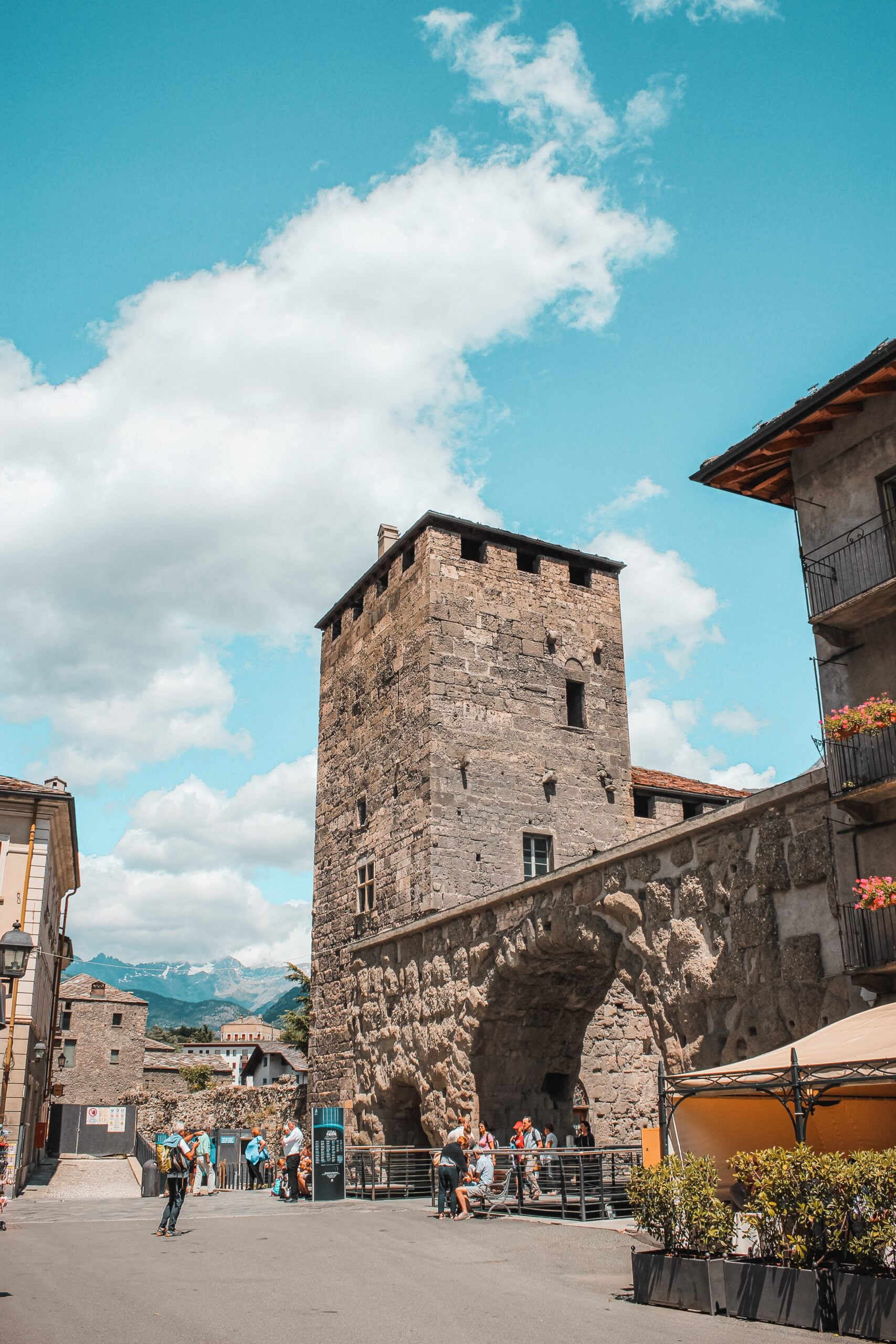
Visitors entered the city primarily through the magnificent Porta Praetoria, the main gateway of Augusta Praetoria. Pedestrians used the side passages, while carts passed through the central archway, directly accessing the decumanus maximus, the city’s longest east–west street.
The Entertainment District
Moreover, walking along the decumanus, one would find the bustling entertainment district. This area included a spectacular 1st-century AD Roman theater, whose monumental façade still survives today. Behind it once stood a smaller amphitheater dating back to the reign of Emperor Claudius.
Where the Forum Once Stood
The ancient Roman forum—the political and administrative heart of Augusta Praetoria—was located where Piazza Giovanni XXIII stands today. This was the busiest and most symbolic area of Roman Aosta.
The Criptoportico Forense
And now, let’s go underground. Just beside the ancient forum lies the extraordinary Criptoportico Forense, a semi-underground covered portico. It remains one of Aosta’s most stunning Roman structures, with elegant arches and a unique atmosphere that transports visitors back 2,000 years.
This space served as a sheltered walkway and a monumental backdrop for public ceremonies, administrative activities, and religious gatherings. Even today, its architectural beauty and excellent preservation make it one of the most impressive archaeological remains in Northern Italy.
Conclusion
Aosta—ancient Augusta—played a crucial role in the control of Alpine routes and Roman military movements. Unsurprisingly, even in antiquity it was already celebrated as Rome of the Alps, a title that still feels perfectly fitting today.
Useful External Links
(SEO-friendly and relevant to Roman history & Aosta)
- Roman Theater of Aosta — https://www.lovevda.it
- Criptoportico Forense info — https://www.visititaly.it
- History of Augusta Praetoria — https://archeologia.beniculturali.it
- Travel guide to Aosta — https://www.italia.it