
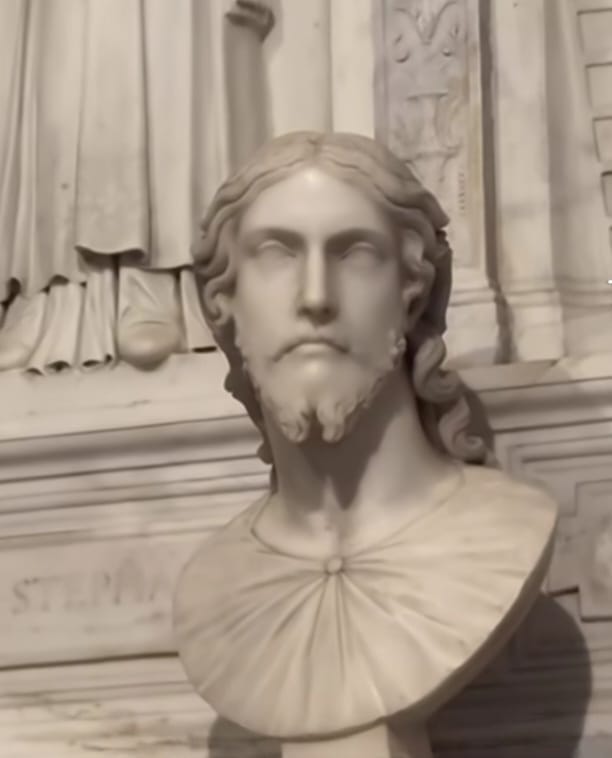

Introduction: Michelangelo’s Hidden Christ Face
Rome is a city where history hides in plain sight. Inside the beautiful Basilica of Sant’Agnese fuori le Mura, a sculpture that stood quietly for centuries has suddenly become the center of an incredible art mystery. the newst Michelangelo’s Hidden Christ Face.
For hundreds of years, this marble bust was simply catalogued as an anonymous Renaissance sculpture. However, recent research suggests something much more exciting: it could actually represent the face of Christ sculpted by Michelangelo Buonarroti.
If this hypothesis proves true, it would be one of the most surprising rediscoveries in Renaissance art. The story of Michelangelo’s Hidden Christ Face reminds us that even today, the Eternal City can still reveal unexpected secrets.
A Forgotten Renaissance Sculpture
For centuries, visitors walked through the basilica without paying special attention to the sculpture. It was simply described as an anonymous work from the 16th century.
However, historians recently began examining historical documents connected to the circle of Michelangelo Buonarroti. These include old inventories, letters, and testimonies written by people who lived during the Renaissance.
Interestingly, some of these documents suggest that the face of Christ might have been modeled after the features of Tommaso de’ Cavalieri, a Roman nobleman who was one of Michelangelo’s closest friends and confidants.
According to the reconstruction, after Michelangelo’s death in 1564, the sculpture may have been preserved by the Lateran canons before eventually arriving at the basilica where it still stands today.
If you want to explore Michelangelo’s life and artistic achievements further, these resources are very helpful:
- https://www.britannica.com/biography/Michelangelo
- https://www.theartstory.org/artist/michelangelo/
- https://www.metmuseum.org/toah/hd/mich/hd_mich.htm
- https://www.wga.hu/html_m/m/michelan/
Michelangelo’s Hidden Christ Face and the Power of Attribution
The story of Michelangelo’s Hidden Christ Face highlights something fascinating about art history: attribution can completely change how we look at an artwork.
Before this research appeared, the sculpture was interesting but relatively unknown. Today, scholars and visitors are suddenly paying attention because it might be connected to one of the greatest artists of all time.
Yet the sculpture itself has not changed.
The marble is the same,
The expression of Christ didn’t change
The emotion it conveys is the same.
What has changed is the possibility that the hand behind it belongs to Michelangelo Buonarroti.
Discovering Hidden Art in Rome
Stories like Michelangelo’s Hidden Christ Face show that Rome still holds countless secrets. While famous landmarks attract millions of visitors, many incredible artworks remain hidden inside quiet churches and forgotten corners of the city.
That is why exploring Rome slowly can be such a rewarding experience. Walking through the city with someone who knows its stories often reveals details that most visitors would otherwise miss.
For travelers who want to discover these hidden gems, joining a walking tour can be a great way to explore the city’s art, history, and legends. You can learn more about exploring Rome on foot here:
https://www.bestfreetour.com/free-tour-rome
During tours like these, visitors often discover lesser-known churches, Renaissance sculptures, and fascinating stories that never appear in typical travel guides.
Michelangelo’s Hidden Christ Face and a Bigger Question
Ultimately, Michelangelo’s Hidden Christ Face leaves us with a beautiful and timeless question.
Does an artwork become a masterpiece because of the famous name behind it? Or because of the emotions it awakens in the people who see it?
Art history is full of incredible works that remained in the shadows simply because their creators were unknown. At the same time, famous names can transform how we perceive beauty and importance.
Perhaps the truth lies somewhere in between.
A great artist like Michelangelo Buonarroti certainly shaped the history of art. But the real power of art appears when someone stands in front of a sculpture, painting, or monument and feels something unforgettable.
And who knows? Somewhere in Rome—or somewhere else in the world—there might still be hidden masterpieces waiting for someone to stop, look closely, and see them with new eyes.