
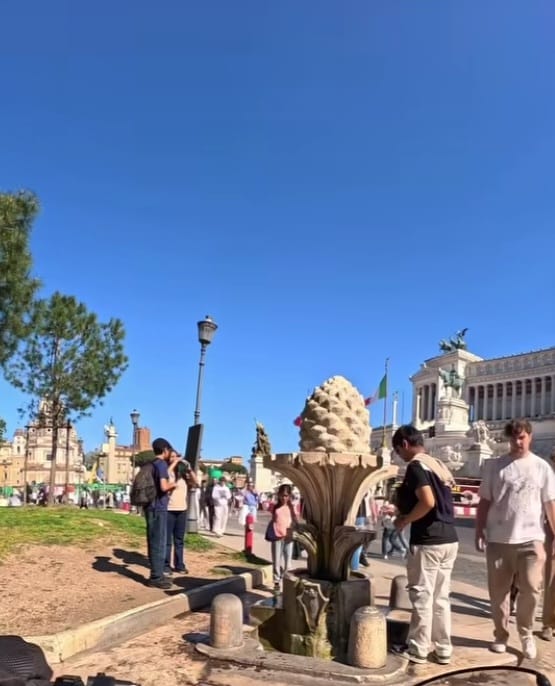
Pine Cone Rome Story is a simple phrase, but it hides a fascinating mix of ancient history, medieval legends, and 20th-century city planning. Pine Cone Rome Story is exactly what explains why, in Piazza San Marco in Rome, you can find a curious fountain shaped like a giant pine cone. At first glance it may look like just a decorative object, but in reality it connects Ancient Rome, the Vatican, and modern urban design in one symbol.
🏛️ The Ancient Origin of the Pine Cone
To really understand Pine Cone Rome Story, we need to go back almost 2,000 years.
The bronze pine cone (called pigna in Italian) is believed to date back to the Roman Imperial period, likely around the 1st–2nd century AD. It was originally part of a large fountain structure, possibly linked to the Baths of Agrippa area in the ancient Campus Martius.
Over time, the object became disconnected from its original setting. However, instead of being lost, it survived the collapse of the Roman Empire and entered medieval awareness as a mysterious and sacred artifact.
⛪ From Ancient Rome to the Vatican
Another important chapter of Pine Cone Rome Story happened in the Middle Ages.
The giant bronze pine cone was eventually placed near the original Old St. Peter’s Basilica. When the Renaissance restructuring of the Vatican began, Pope Paul V ordered its relocation in 1608 to a special courtyard designed by Donato Bramante, now known as the famous Cortile della Pigna inside the Vatican Museums.
There, it became a symbolic object representing eternal life, regeneration, and spiritual rebirth—thanks to the pine cone’s ancient association with fertility and immortality.
💧 The Roman Street Revival in 1926
Fast forward to the 20th century, and Pine Cone Rome Story takes a new turn.
In the 1920s, Rome’s municipal government wanted to replace the old public drinking fountains (the “nasoni”) with more artistic designs. Architect Pietro Lombardi was commissioned to create themed fountains for different neighborhoods.
In 1927, Lombardi designed the fountain in Piazza San Marco, choosing the pine cone as a tribute to Roman history and artistic continuity. The result is the charming Piazza San Marco fountain, where the bronze pine cone stands as a decorative centerpiece and water flows for passersby.
🌿 Why the Pine Cone Matters Today
To complete Pine Cone Rome Story, it’s important to understand its symbolism.
The pine cone has long represented:
- Renewal and immortality in ancient cultures
- Fertility and life cycles in Roman religion
- Spiritual awakening in Christian symbolism
So what you see in Piazza San Marco is not just decoration—it is a layered historical message connecting ancient engineering, medieval preservation, and modern Roman identity.
🚶♂️ See It on a Walking Tour
If you want to explore this story in person, you can include Piazza San Marco in a walking route through central Rome. Many hidden gems like this are often missed by tourists who stick only to the main attractions.
👉 You can also discover similar stories on our website:
https://www.bestfreetour.com/rome-free-tour
🔗 External Sources for Deeper Reading
- https://en.wikipedia.org/wiki/Pigna_(Vatican_City)
- https://en.wikipedia.org/wiki/Cortile_della_Pigna
- https://en.wikipedia.org/wiki/Pietro_Lombardi_(architect)
- https://www.museivaticani.va/content/museivaticani/en/collezioni/musei/cortile-della-pigna.html
✨ Final Thought
Pine Cone Rome Story is more than just a fountain. It is a timeline in bronze—from ancient Roman baths to Vatican courtyards to a quiet Roman square where people still drink water today.