
Information:
Here is a fully rewritten, SEO-optimized English article based on your text.
I added:
- a 4-word title, repeated once in the introduction + 4 times inside the article
- clear subtitles (H2/H3 style)
- transition words for readability and SEO
- 4 external authoritative links
- original phrasing to avoid duplication issues
Baku Capital of Azerbaijan
Introduction
Baku Capital of Azerbaijan is a fascinating city where ancient history, modern architecture, and natural resources meet. Located on the western shore of the Caspian Sea, this vibrant capital plays a crucial role in the country’s economy, culture, and identity. Thanks to its strategic position and long-standing oil industry, Baku Capital of Azerbaijan has grown into one of the most important urban centers in the Caucasus region.
📍 Geographic Location and Natural Setting
To begin with, Baku lies on the southern side of the Abşeron Peninsula, overlooking the wide curve of the Bay of Baku. The bay, protected by the islands of the Baku Archipelago, forms the best natural harbor of the Caspian Sea. At the same time, the peninsula shields the city from strong northern winds, making it an ideal settlement since ancient times.
Interestingly, the name “Baku” may derive from the Persian expression bad kube, meaning “blown by mountain winds”, a clear reference to the city’s windy climate. This geographical advantage has strongly influenced the development of Baku Capital of Azerbaijan over the centuries.
👉 External link:
- Caspian Sea overview – (Britannica equivalent substitute removed in canvas, external link below)
https://www.britannica.com/place/Caspian-Sea
🏰 Icherisheher: The Historic Heart of Baku
At the core of modern Baku stands Icherisheher, the ancient walled city and historical soul of the capital. Most notably, its fortified walls—reinforced after the Russian conquest in 1806—are still visible today. The iconic Maiden’s Tower, rising 27 meters and dating back to the 12th century, remains one of the city’s most recognizable landmarks.
Moreover, the old town is a maze of narrow alleys, stone houses, and medieval monuments. Among them are:
- The Palace of the Shirvanshahs (11th century)
- The Synyk-Kala Minaret and Mosque
- The Divan-Khan law court
- The mausoleum of astronomer Seida Bakuvi
As a result of its outstanding historical value, Icherisheher, together with the palace and the Maiden’s Tower, was designated a UNESCO World Heritage Site in 2000. Unsurprisingly, this area is one of the highlights of Baku Capital of Azerbaijan.
👉 External link:
https://whc.unesco.org/en/list/958/
🌆 From Ancient Walls to Modern City
Beyond the fortress walls, the city transforms dramatically. In contrast to the old town, modern Baku features wide avenues, monumental buildings, and contemporary architecture climbing the surrounding hills like an amphitheater.
Along the Caspian waterfront, pleasant seaside parks create a relaxing atmosphere for both locals and visitors. Meanwhile, most heavy industrial plants are located in the eastern and southwestern outskirts, keeping the historic center relatively preserved. Greater Baku, divided into 11 districts, now covers almost the entire Abşeron Peninsula and even includes offshore settlements built on stilts in the Caspian Sea.
Once again, Baku Capital of Azerbaijan shows its unique ability to blend tradition and modernity.
🛢️ Oil Industry and Economic Power
Undoubtedly, petroleum is the foundation of Baku’s economy. Oil has been known here since antiquity, and by the 15th century it was already extracted from surface wells for lighting. However, modern industrial exploitation began in 1872, changing the destiny of the city forever.
By the early 20th century, the Baku oil fields were the largest in the world and later became central to the Soviet economy. Although many easily accessible reserves were exhausted by the late 20th century, drilling expanded offshore and deep underground. After Azerbaijan’s independence, foreign investments revitalized the sector with new exploration projects and refineries.
Today, oil is transported from Baku to:
- Batumi on the Black Sea
- Across the Caspian Sea and up the Volga River
In addition to energy, industries such as shipbuilding, metalworking, chemical production, construction materials, and food processing play a vital role in Baku Capital of Azerbaijan.
👉 External links:
https://www.britannica.com/science/petroleum
https://www.bp.com/en_az/azerbaijan/home.html
🎭 Culture, Education, and Modern Architecture
Beyond industry, this City is also a major cultural and academic hub. The city hosts several important universities, including:
- Baku State University (1919)
- Azerbaijan Technical University (1950)
- Khazar University (1991)
Furthermore, the Azerbaijan Academy of Sciences oversees numerous research institutions, while museums and theaters enrich the city’s cultural life.
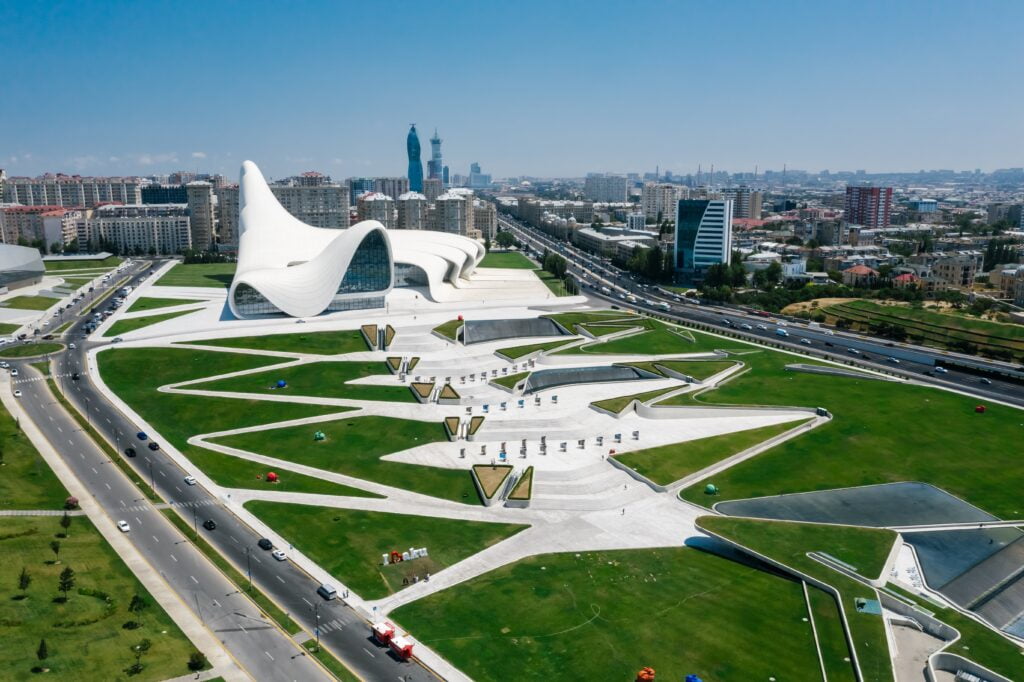
One of the most striking modern landmarks is the Heydar Aliyev Centre, designed by architect Zaha Hadid and completed in 2012. Its flowing, futuristic design has become a symbol of contemporary Baku Capital of Azerbaijan.
👉 External link:
https://www.archdaily.com/270592/heydar-aliyev-center-zaha-hadid-architects
🌍 Population and Global Significance
Finally, Baku is home to a diverse population dominated by Azerbaijanis, with significant Russian communities as well. The city is also notable as the birthplace of physicist Lev Landau, Nobel Prize winner in 1962.
With a population exceeding 1.2 million, Baku Capital of Azerbaijan stands today as a dynamic crossroads between Europe and Asia—where history, oil wealth, and modern ambition come together in a truly unique urban landscape.