Discovering Florence’s Hidden Corners
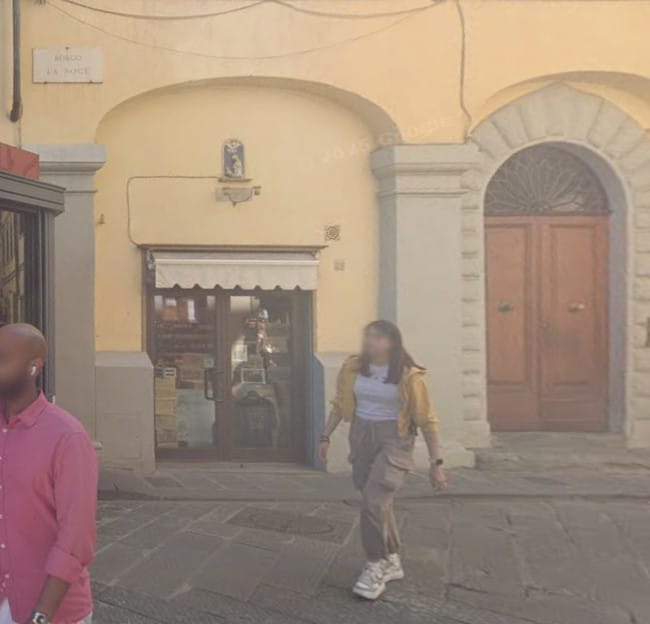
In the heart of Florence’s San Lorenzo district lies a street that whispers stories of the past: The Secret of Borgo La Noce. Its name alone evokes the scent of countryside and mystery. Once, this “Borgo” was a small road leading outside the medieval walls—specifically through a little northern gate of the ancient city wall built between 1173 and 1175.
From Countryside to City Life
The second part of the name, La Noce (“The Walnut”), is even more intriguing. It likely refers to a solitary walnut tree that once grew here, back when this part of Florence was nothing but orchards and open fields. Over the centuries, as the city expanded, The Secret of Borgo La Noce transformed from a rural passageway into a lively urban street, yet it still preserves that echo of nature and simplicity.
For more about the San Lorenzo district, explore Visit Florence’s guide.
A Hidden Treasure at Number 8
At number 8 of Borgo La Noce, if you lift your eyes, you’ll notice a small yet captivating tabernacle. Commissioned by Giuseppe Mondei in the early 19th century, this terracotta artwork is a glazed copy of Andrea della Robbia’s Adoring Madonna. However, there’s a delicate difference: instead of the group of angels seen in the original, here appears a single cherub and the Dove of the Holy Spirit.
The original masterpiece can be admired at La Verna Sanctuary, nestled among the mountains of Tuscany—a place deeply linked with Franciscan spirituality. But here, in the bustling heart of Florence, The Secret of Borgo La Noce carries that same devotion in a quieter, urban form.
Spiritual Florence: Faith in the Streets
This small terracotta shrine is more than decoration; it’s a fragment of popular spirituality that still resists the passage of time. Between the stone walls and the steady rhythm of city life, the devotion of the people remains alive. It’s a beautiful example of how faith and art merge in Florence, creating symbols that are both sacred and familiar.
For an overview of Florence’s religious art, check Uffizi Galleries official site.
Between Memory and Mystery
Even today, Borgo La Noce preserves its charm—simple, enigmatic, and almost vegetal, like the walnut tree that gave it its name. The Secret of Borgo La Noce is not just about a place; it’s about the continuity of Florence’s soul, where art, faith, and memory intertwine quietly among the streets of San Lorenzo.
For more insights into Florence’s hidden corners and history, visit Discover Tuscany.