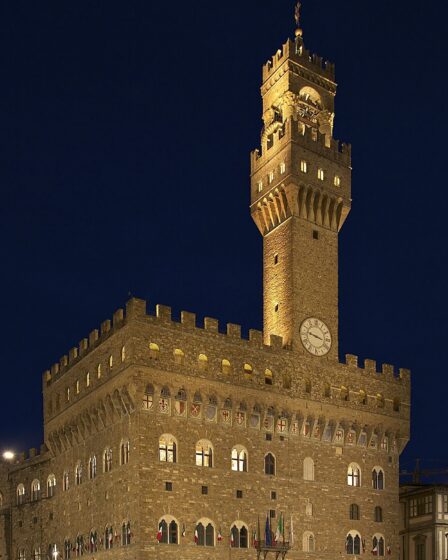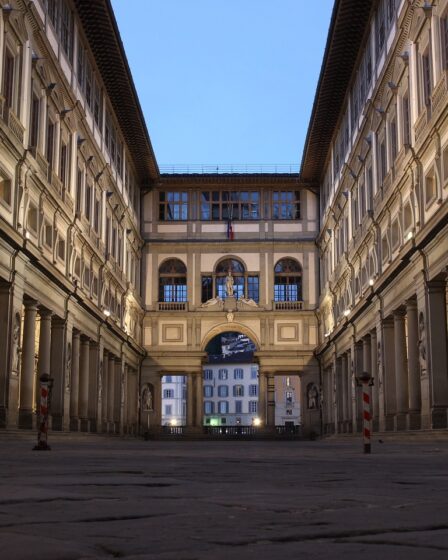
Perhaps not everyone knows about the existence of a corridor that starts from Palazzo Pitti performes concludes near the Galileo Tribune in the Specola Museum. This architectural space was to be the “appendix” of the famous corridor of the “Prince” or Vasarian. We are talking about the so -called Pocciantini corridor, it was made by Pasquale Poccianti in 1820 to allow Ferdinand III to have a connection with the adjacent Palazzo Pitti, thus creating an uninterrupted route that allowed him to arrive at Palazzo Vecchio through the Vasarian corridor.
Accademia Gallery 2023, two million visitors
he Accademia Gallery closed its doors in 2023 after welcoming over two million visitors—2,013,974—a record never before attained by the public. This means that the magnificent David by Michelangelo, which has always been a popular focal point, is no longer packed with people. Not only does this location have “museums inside the museum” like the department of musical instruments and the gipsoteca, but they are scattered throughout every room.
St. Appolinare in Florence its history
Piazza San Florence has altered several times over time, beginning with the Roman era, when the city’s defenses were built here. If you walk in front of the Bargello Museum, you will notice a semi-circle on the street that marks the Roman tower unearthed by Annifa beneath the road surface. One of these little-known improvements is located just near to the Bargello Museum. We are discussing the church of S.Apollinare in its distinctive form, but it is a rather ordinary building. In truth, that little church was one of the twelve churches of the Priories of Florence, possibly built in the sixth century AD under the control of the Goths of Theodoric, and was dedicated to Apollinare, a Ravenna martyr of Syrian ancestry. The two notarial acts of January and February 1065 are dated back to the mid-twentieth century… “Vinea Sancti APPOLENARI” (the vineyards of S.Apollinare, at that time there were vineyards worked by the monks) and “Petium Terre Posite Extra Muros Civitatis Florentie Prope Ecclesiam Sancti Apollinaris” (request for land located outside the walls of the city of Florence near the church of Sant’Apollinare).
Ancient refrigerator of Florence
Certainly since the mists of time food conservation has always been a fundamental if not primary element for human nutrition. So everything that could be useful in the use to slow down the deterioration and prevent those phenomena of proliferation of pathogens was very important. The most common systems were those of the salt, of clerk, of use of fresh environments but above all the use of ice. The difficulty of finding ice in hot periods developed a simple but not banal expedient, that is, the creation of the “refrigerators” of the time known as Ghiacciaie or “Diacciae” in Florentine. But many cities were not close to the mountains so something had to be devised immediate functionality.
Best gelato makers of Florence and Tuscany
The best artisan ice cream shop in Tuscany is located in Florence, in Oltrarno, followed closely by another Florentine ice cream parlor, while on the third step of the podium are Sale Grosseto, Pisa, and San Gimignano: this is the map drawn up by Gambero Rosso in its guide to Gelaterias of Italy 2024. The whole ranking will be announced on March 24, in honor of Ice Cream Day, but in the meantime, the first advances of the eighth edition of the publication have been disclosed. The occasion was the Sigep of Rimini, one of our country’s most prominent salons in the pastry and coffee world.
San Zenobi miracle in Duomo square
According to tradition, on January 26, 429, the body of San Zanobi, bishop of Florence, was transferred from the Basilica of San Lorenzo to the Cathedral of Santa Reparata. However, along the way, near the north door of the baptistery, the saint’s relic touched a dry elm, and despite the fact that it was full winter, the tree rejected.
Carnival In Florence 2024
The Florence Carnival will begin on Saturday, January 27, with the Grand Ball at the Palazzo Vecchio, followed by a big parade in the center free to anyone. The 27-day program allows travelers to enter through the Cortile del Michelozzo. The masks, created by Florentine craftsmen using the papier-mâché processing technique, will be distributed here. Sters, a mask icon of the Florentine carnival developed in the eighteenth century by the artist Luigi Del Buono and rising to the “identity” of the territory, will greet those present. With him, several judicial figures will accompany persons in the presence, like the master of ceremony.
Roman terms next Florence’s Porcellino
Walking in the street Por Santa Maria, where yo can find Dr Martens shop side sidewalk, towards Ponte Vecchio, in front of the current Falconeri shop, there are three panes, each divided into four glass tiles (now very consumed due to the passage of people), through which you could once see what remained of the …
Duilio 48 and the church of St. Bartolomeo
In 1888, the pope brothers built the “Great Emporio Duilio” on the ruins of a medieval church; the name was later adopted by the Royal Marina battleship “Caio Duilio.” The inside was decorated in a maritime theme, and even the clerks were costumed like sailors. Giuseppe Siebzehner, the owner, renamed the warehouses “Emporio Duilio 48” …
Renaissance Pharmacy in Florence
Almost everyone knows that Florence during the Renaissance period was very famous for various activities including that of the arts with and sculptors, architects, painters, who gave prestige to the city of Florence up to our tear. But not many know that Florence besides the artists was also famous for spices and in particular for some pharmacies led by friars of various orders scattered throughout the city. One of the most famous is that of Santa Maria Novella in via della Scala, led by Domenican friars. But there were also other pharmacies, one of the lesser known but always important for the city and for its stria was that of Santissima Annunziata, led by the Benedictine nuns, who directed the hospital of Santa Maria Nuova.