What we see in the photo is not the famous Raffaello masterpiece that many of you will certainly have already admired to the Uffizi. It is a copy and is located in the National Gallery of Capodimonte in Naples. It is said that one day Federico Gonzaga visiting Florence had been amazed by the beauty of this picture performed by Raffaello on behalf of Pope Leo X who had made himself portrayed together with the cousin Cardinal Giulio dei Medici (that is, the one destined to become Pope Clement VII) And to the other cardinal/cousin, Luigi de ‘Rossi. Federico Gonzaga asked that picture as a gift and Clement VII told him yes. When Ottaviano dei Medici he knew him a blow: no, he could not let herself leave lightly the masterpiece. So it was that Ottaviano decided to deceive the Pope, asking him for permission to be able to take the picture to equip him with a more beautiful frame. In reality Ottaviano called in secret Andrea del Sarto to make a copy, a copy that had to be perfect. Andrea del Sarto performed it. The result is what we see in the photo: I challenge anyone to recognize it from the original of Raffaello. The “crust”, if you can speak of crust, was sent to Mantua. Among other things, Giulio Romano, ex-Collaborator, indeed, worked in Mantua, indeed, Raffaello’s right arm, who had also taken part in the drafting of the original picture. It seems that not even he realized that it was a copy, so much had been well performed by Andrea Del Sarto who was not for nothing, the “painter without errors” was nicknamed.
Tradition
Sweets and cocktails in Florence
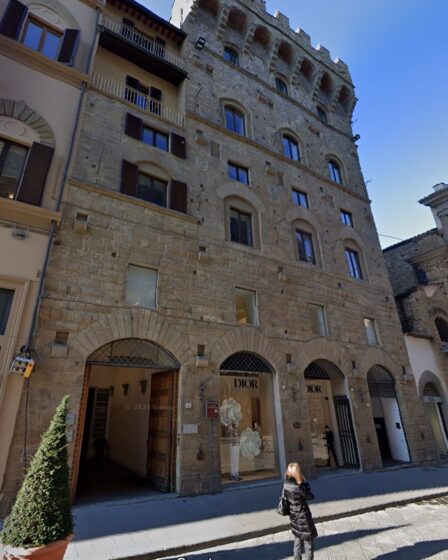
Once at the Agolo di via delle Oche and via dei Calzaiuoli, there was a loggia, still visible from the arches of the shops. The loggia belonged to the family of the hatyaries of the Guelph part, and like so many wealthy of the time having such a building was a sort of presentation ticket to the population, parties, weddings and receptions of various kinds were made inside it. But this was called or rather nicknamed “La Neghittosa” (from the Latin neglectus -Svogliato -Pigro), then a meeting place for time and listless, later transformed into the tavern was in the centuries absorbed by the houses. In the first half of the 1700s and more precisely in 1733 the Swiss family Gilli opens in via Calzaiuoli “La Bottega dei Pani sweets”, a real world of various sweets, jams, pastry.
Schiacciata Fiorentina, traditional Carneval’s Cake
At Carnival in February Florence is transformed with many innumevoli weekly activities. But one of the most famous and unique things in Florence is the typical dessert the legendary crushed to Fiorentina. Or how the citizens of Florence love to call Sperizoly Stiacciata of Florence. Let’s see the origins of this ancient traditional dessert of Florence. Scock because it seems to have origin from the red of the eggs that were crushed inside the bowls where the copost Diesso were mixed. But the original name in the one thousand eight hundred was crushed greased. Thus called her pilgrim arusor father of Italian and Tuscan cuisine of origin. He lived in Florence for a few years where he wrote his book on Italian cuisine.
Santo Spirito area a pearl inside of Florence
A vibrant districts with distinct locations are: strolling aimlessly and allowing yourself to be taken aback by the numerous artisan stores in our tours we are suggesting some; one of our favorites is situated on the ground floor in front of the Chesa di Sant Spirito Number 12 following turning right through the atrium gate, Giuliano Ricci’ artisan laboratory awaits you. Stefano is one of the remaining masters of copper decorating. This is an activity that we may recommend if you wish to have a special experience while in Florence. One of Florence’s newest traditional butchers may be found on the same street as Santo Spirito.
Sciacciata alla Fiorentina competition in town
It was decided to increase the number of finalists to 31 and conduct a pre-selection in tandem due to competitors and ways of handling the extremely high number of requests received by the Competition Directorate (over 50). The judges concluded that the final-crushed finalists were, in fact, the greatest in the metropolitan region.
Church of Santa Maria Sopra Porta
Recalling that in 1038, it was given the name Por “Santa Maria” and acquired the appellation “above Porta” due to its location at the southern entrance of the Carolingian fortifications. Here, in 1216, the combination marriage of Buondelmonte de ‘Buondelmonti and reparata of Lambertuccio degli Amboi was required; however, the bride’s rejection resulted in the customary partition of the city into two factions, subsequently referred to as Ghibellines and Guelphs. Additionally, this is the suggestion that Moscow’s Lamberti would have given, using the well-known statement that the head made to persuade the Hamidii to assassinate Buondelmonte. Ghibeline families, including the Uberti, Arrighi, Fifanti, and Ambreans, really made up the majority of the parish’s population.
Secret passage in Pitti Palace
Perhaps not everyone knows about the existence of a corridor that starts from Palazzo Pitti performes concludes near the Galileo Tribune in the Specola Museum. This architectural space was to be the “appendix” of the famous corridor of the “Prince” or Vasarian. We are talking about the so -called Pocciantini corridor, it was made by Pasquale Poccianti in 1820 to allow Ferdinand III to have a connection with the adjacent Palazzo Pitti, thus creating an uninterrupted route that allowed him to arrive at Palazzo Vecchio through the Vasarian corridor.
St. Appolinare in Florence its history
Piazza San Florence has altered several times over time, beginning with the Roman era, when the city’s defenses were built here. If you walk in front of the Bargello Museum, you will notice a semi-circle on the street that marks the Roman tower unearthed by Annifa beneath the road surface. One of these little-known improvements is located just near to the Bargello Museum. We are discussing the church of S.Apollinare in its distinctive form, but it is a rather ordinary building. In truth, that little church was one of the twelve churches of the Priories of Florence, possibly built in the sixth century AD under the control of the Goths of Theodoric, and was dedicated to Apollinare, a Ravenna martyr of Syrian ancestry. The two notarial acts of January and February 1065 are dated back to the mid-twentieth century… “Vinea Sancti APPOLENARI” (the vineyards of S.Apollinare, at that time there were vineyards worked by the monks) and “Petium Terre Posite Extra Muros Civitatis Florentie Prope Ecclesiam Sancti Apollinaris” (request for land located outside the walls of the city of Florence near the church of Sant’Apollinare).
Ancient refrigerator of Florence
Certainly since the mists of time food conservation has always been a fundamental if not primary element for human nutrition. So everything that could be useful in the use to slow down the deterioration and prevent those phenomena of proliferation of pathogens was very important. The most common systems were those of the salt, of clerk, of use of fresh environments but above all the use of ice. The difficulty of finding ice in hot periods developed a simple but not banal expedient, that is, the creation of the “refrigerators” of the time known as Ghiacciaie or “Diacciae” in Florentine. But many cities were not close to the mountains so something had to be devised immediate functionality.
Best gelato makers of Florence and Tuscany
The best artisan ice cream shop in Tuscany is located in Florence, in Oltrarno, followed closely by another Florentine ice cream parlor, while on the third step of the podium are Sale Grosseto, Pisa, and San Gimignano: this is the map drawn up by Gambero Rosso in its guide to Gelaterias of Italy 2024. The whole ranking will be announced on March 24, in honor of Ice Cream Day, but in the meantime, the first advances of the eighth edition of the publication have been disclosed. The occasion was the Sigep of Rimini, one of our country’s most prominent salons in the pastry and coffee world.